Board of Trustees Backs Down on Reorganization
July 11th, 2007From the Daily Hampshire Gazette
UMass to shift focus Tocco: For now, restructuring is out of the picture
By KRISTIN PALPINI Staff Writer
AMHERST - To the relief of many at UMass Amherst, the University of Massachusetts is moving away from plans to overhaul top-level management and will instead focus on increased campus collaborations, according to trustees chairman Stephen P. Tocco.
On Tuesday, Tocco said he doesn’t expect any significant governance changes for the five-campus university system unless such a move is suggested by Gov. Deval Patrick’s Readiness Project, a panel appointed to implement Patrick’s pre-kindergarten through higher education proposals. The project recently was given the added responsibility of reviewing the UMass system.
‘I would think that we’re going to set that aside unless in the process the task force says that this is absolutely something we should be doing,’ Tocco said.
Meanwhile, Tocco said he expects that an interim chancellor will be named for the Amherst campus within the next few weeks if UMass Amherst Chancellor John V. Lombardi is chosen the new president of the Louisiana State University system. A vote on Lombardi’s appointment is expected by the end of the week.
Tocco’s thoughts about UMass plans are a step away from what university administrators have been proposing since mid-May. For over a month, the UMass president’s office and trustees have been talking about starting a yearlong study of governance models. The first governance design specifically floated was a ‘lead campus’ model in which the president and flagship chancellor position would be combined.
Still, the goal remains the same, Tocco said. Both the governance study and the collaborations focus seek to boost UMass’ stature by unifying the system.
‘This is more focused on how do we get more collaboration and more systemwide cooperation,’ Tocco said. Organizing UMass into a lead campus model was one way of achieving this goal, Tocco said, ‘but there is more than one way to reach this objective.’
A unified UMass has been the hallmark of Wilson’s and Tocco’s public addresses since the reorganization study was proposed. The idea also falls in line with Wilson’s ‘Vision of One University,’ a 10-page PowerPoint presentation that seeks to centralize some UMass operations and have all five campuses trumpet a united message.
In Amherst, Tocco’s comments taking the restructuring of top-level management off the table for now were welcome news. Reorganization plans had met harsh criticism from faculty, students, western Massachusetts politicians and some trustees, many of whom cited the seemingly secretive way the proposals were created. Many accused UMass administrators of trying to implement changes without open dialogue among constituents.
‘This is great news. This is what we had been hoping for,’ said Max Page, president of the UMass Amherst chapter of the Massachusetts Society of Professors.
Page said he agrees with Tocco that if Patrick’s group finds that a change in governance is what UMass needs, the university should consider it. However, Patrick’s group may not investigate governance models for the university. The Readiness Project is charged with reviewing the system with a focus on increasing cross-campus collaborations. UMass Amherst faculty are in the process of forming their own committee to study the university system’s performance and governance.
‘The system we have now is not perfect,’ Page said. ‘Everyone, especially the faculty, loves to study new ideas. Now that the governor’s Readiness Project is going to look at this - it’s ideally what we wanted.’
Page also noted that UMass’ decision to forgo a governance study could have a positive impact on the university’s search for a new flagship chancellor.
‘This will make the search go much better in all accounts,’ Page said. ‘We’ll get better candidates if they (the candidates) don’t feel like there is a route already laid out on the table to shape their leadership.’
In May Wilson divulged details of a proposed yearlong study of university management systems. At the same time, he announced a rearrangement of chancellors under which Amherst chancellor Lombardi was to leave his position after the 2007-08 academic year.
Open Letter to Faculty, Please Support Graduate Students at UMass
May 24th, 2007Dear Faculty Members:
As you may know, the University and the Graduate Employee Organization (GEO)/UAW Local 2322 are currently in contract negotiations for a seventh agreement. We’ve been bargaining for 5 months, and have reached very little agreement with the administration. We would like to take an opportunity to open a dialogue with you and to share our thoughts on why these negotiations have been unproductive thus far.
Like any union, GEO surveyed its members prior to bargaining, and we based our proposals on the collective desires of our members to improve their working conditions and, we believe, at the same time improve the university as a whole. Our members overwhelming said they supported several things: rolling back mandatory fees which have increased more than 126% since 2001; getting cost of living raises; increasing job security, and improving structures that support a diverse student body, such as childcare support and diversity funding. Though the administration will claim that we have made an inordinate number of proposals, we can assure you that we are ready to reduce that number significantly to the core issues described above in the event that the administration begins to bargain in good faith and with full authority to discuss all issues, including financials.
So that you can get a sense of the objectives and thought behind our core proposals, we’ve provided a bit of information below:
Cost of living increases and rolling back fees:
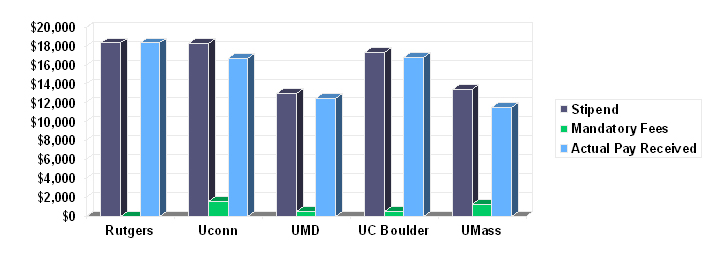
Unfortunately, the standing of UMass graduate employees has significantly withered in relation to grad employees at our peer institutions. When you look at what’s left in graduate employees’ pockets after they subtract mandatory fees from their stipends, UMass falls dead last among its peers, and we think this means fewer grads will chose UMass. Why come here when they can receive a more compelling offer just down the road at UConn (where the average compensation package is $5000 greater than at UMass) or Rutgers, where graduate student fees were eliminated in the most recent grad employee union contract?

Our wage and fee proposals are intended to begin to address this disparity (although if UMass accepted our current proposal today, we would still be behind our peers). The combination of the two is meant to address the fact that every time our wages go up, they are almost entirely subsumed by the cost of rising fees.
We believe that we all have a stake in reducing mandatory fees—undergraduates, graduate students, and faculty. We have made the same proposal as MSP with regard to the curriculum fee because we see how this fee cripples departments, particularly when it comes to procuring grants for research. Were we to eliminate this fee charged per graduate employee to employing departments, we could hire 425 new graduate researchers or 95 new faculty, significantly increasing the capacity for cutting-edge research at UMass. We would all benefit from this.
Job Security
We know that you may have some reservations about our proposals in this area, and for this reason, we welcome your feedback. All we know is that many graduate employees feel an ever-present insecurity around their employment, and this isn’t conducive to learning, teaching or conducting research. We’ve made a few proposals in this area. The first is that we’d like more clarity in the language governing appointment/reappointment; however, we want to assure you that our proposal in no way infringes on your authority as management to make hiring decisions.
We’ve proposed that appointment/ reappointment policies either include option #1) standardized criteria for each position (TA, TO, RA) which address what qualifications are prioritized for funding for each position: e.g., how important is previous teaching experience vs. research experience, how is departmental progress weighted, and other criteria, such as how work performance in the department is evaluated with regard to future employment or option #2) that when graduate employees aren’t hired for a position they apply for, they be provided with a rationale for the decision. Let’s flesh these out: In the case of option #1, we aren’t interested in any way in dictating your positions on these questions, but believe it is reasonable that you take a position on these criteria, and be transparent about it. For instance, it would be fine to say that a) you prioritize funding 1st years, b) you prioritize funding those later in their program, or c) you prioritize 1st years in some cases and more advanced students in others, etc. This is not taking away your managements’ rights—this is asking you to make your management prerogatives clear to those trying to get hired, which we believe will reduce the kind of acrimony that develops when people feel they’re being left in the dark
Alternatively, we’ve proposed some minor reporting to the candidate about why they weren’t hired. This would only help potential graduate employees become better candidates in the future. In the end, we feel that if the administration can’t agree to a clear announcement of criteria within departments or programs before decisions are made, nor to a reporting after the fact, that the result is a lack of transparency unbefitting of a public institution.
In addition, we’ve proposed that all graduate employees who receive guarantees of employment receive at least 380 hours of employment in an academic year. The figure of 380 hours per academic year (i.e. 10 hours/week/semester) comes from the minimum earned dollar limit ($6688/academic year) set by the graduate school to be eligible for the tuition waivers and health benefits. 380 hours of employment at the minimum GEO stipend is $6935. Under our proposal, these 380 hours could come from one position, or from any combination of positions. Though it does not provide a graduate student a living wage, the minimum employment level we propose ensures that all graduate employees will receive benefits such as tuition waivers and health fees. While we’ve tried to acknowledge the constraints faced by departments in providing full employment, we also know that underemployment is one of the main reasons for which graduate students leave before completing their programs. The constant financial insecurity affects the academic progress of our members, as evidenced by the 46% dropout rate among UMass-Amherst graduate students. We believe that ensuring that, at the least, all graduate employees receive tuition waivers, fee waivers, and health benefits, can make a real difference in the ability of graduate employees to complete their programs.
In the current system departments pay a small health chargeback of $2.50/hour for each graduate employee. However, if a given graduate employee doesn’t meet the minimum total earning requirement, he or she does not receive health benefits, despite the fact that the department is paying into the benefit pool on his or her behalf. By ensuring that all graduate employees reach a minimum level of employment, we can also ensure that departments are not wasting their scarce resources by paying towards a benefit that their employees will not receive. A department, for example, that pays someone for eight hours of work per week at the campus minimum is paying $380/semester in health fee chargebacks, but the employee in question does not receive health benefits. Were that department to increase the employees hours to 10/week, the department would pay a total of $95 in additional health fee chargebacks, and the employee in question would receive a health fee waiver worth up to $2,200. We’re wasting scarce resources by failing to ensure these minimum levels of employment.
Our message with this proposal is simple—if you want to bring a graduate employee here, and ask them to commit to the university by moving hundreds or thousands of miles from their home, make a commitment to them of a minimum level of funding. We think it will: improve the retention of grads in your programs and help them focus on the core issues at hand of learning, teaching and research. If you can help us find the way to this goal through another course, we are willing to work with you.
Childcare:
Our proposal includes increasing the amount the university contributes to vouchers for low income students and asks the university to commit to maintaining an adequate and safe childcare center on campus. The administration has soundly rejected this proposal. We know that greater numbers of graduate students and faculty are coming to the university each year with young families—despite this reality, the university childcare center has long waiting lists, is housed in “temporary†buildings whose life expectancy is about to expire, and has mold problems. In addition, the voucher fund, which is provided for use mainly at off-campus sites when the center here is full, isless than half of what is needed to support graduate families on campus.
Diversity Funding:
Our contract provides $800,000/year to fund a diverse student body. Traditionally, this has been accomplished through fellowships to outstanding diverse graduate students. However, recently and unilaterally, the administration removed many fellowships from the Humanities and Social Sciences, and used a large chunk of the fund to match an NSF grant to bring diverse students to the Natural Sciences and Engineering programs (NEAGEP). We applaud the effort to bring minorities to the sciences but we equally believe the other disciplines on campus deserve the same effort.
The administration has made contradictory statements about the current situation. Graduate Dean Mullin has said both that the NEAGEP program was brilliantly successful and a model, and also that it would not be something he would want to continue in the future. We consider NEAGEP to be a successful program because it clearly identifies its intent to fund minorities and it takes a centralized, institutional approach to this effort. We would, however, like to see a more equitable division of diversity funds and the implementation of a similar program within the Humanities and Social Sciences. The administration has said that it is unwilling to do either—
unwilling to say that our $800,000 should fund minorities equally and unwilling to take institutional responsibility for creating a more diverse graduate student body. The administration has taken the position that eac department should be responsible for its own “acts of diversity.â€
In summary, we hope to share with you our perspective on the current negotiations and invite you to find out more. You can read our proposals at www.geouaw.org and we’re happy to answer questions or take suggestions at 413-545-0705 or geo@external.umass.edu.
Sincerely,
Nate Johnson
President
UMass Graduate Employee Organization
Bargaining Update from May 18 2007: What’s At Stake
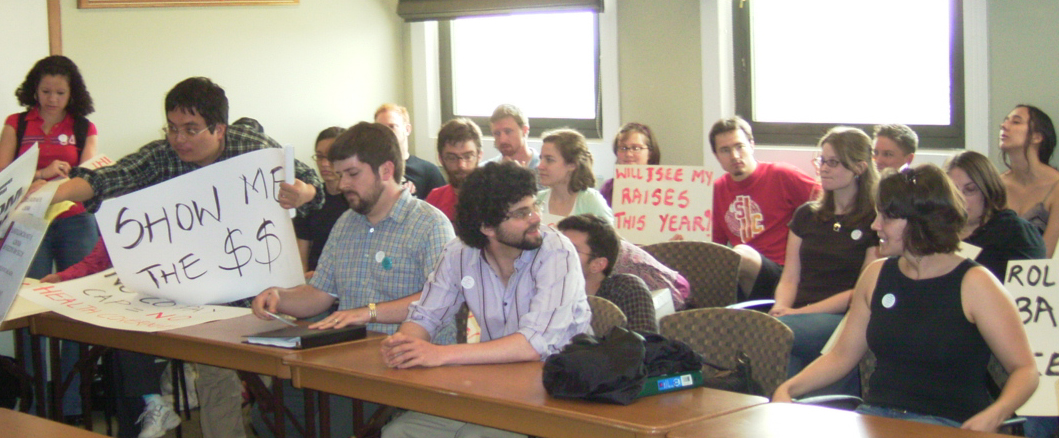
May 22nd, 2007On May 18th over 80 GEO members showed up to support GEO’s bargaining team in our 13th bargaining session with the University. A wide variety of departments were represented at this session, from Electrical and Computer Engineering to History; from Sociology to Computer Science; from Plant & Soil Sciences to Education to Spanish & Portuguese.
While the University appears to be taking baby steps toward responding to the increasing pressure being applied by graduate student employees and their supporters who are frustrated with 5 months of unproductive bargaining, we’re not there yet…Our bargaining team let the administration know that a contract we can support has to include improvements in all of the areas outlined below. What happens next depends on you and on the participation of all GEO members in our campaign for a contract that takes us forward instead of backwards.
At the session, the University formally made its first comprehensive economic proposal and these are the highlights:
Bargaining to Win: GEO Members Show Up at the Bargaining Table
May 12th, 2007
On May 11th GEO Members showed up from departments across UMass to pack the bargaining room and show the administration they stand behind a contract that takes GEO members forward instead of several steps backwards on mandatory fees, health care, and funding for diversity across campus. Many members plan to turn up for bargaining with the Umass administration next Friday at 1:30 May 18th in the Campus Center as well.
Here’s what Chris Fobare a member from the History Dept. who came on May 11th had to say to his fellow GEO members in History afterwards:
Hello everyone,
I wanted to send out an e-mail about the GEO contract negotiations
that occurred today. I, along with several other history department
members, attended a packed session of the ongoing bargaining
session between GEO and the administration negotiators at the
Campus Center this afternoon. For the first time, after four months of
negotiations, the administration offered an “off the record”
financial package, which I’m sure that anyone who is a teaching
assistant/research assistant in the department would be offended by.
I know that we are all busy finishing up work for our own classes and
grading papers, but I would seriously encourage all grad students to
make the trip to campus for the next bargaining session (tentatively
scheduled for next Friday at 1:30). Yes, I know that next Friday is
a day that most of us will not be on campus, but your income for next
year is at stake. Today’s bargaining session was approximately one
hour—we can all take that out of our schedule.
The reason that I have taken it upon myself to send this email out to
everyone is because I think that all of you, as employees of UMass,
would be appalled by the arrogance and combativeness of the
administration negotiators (I am in no way exaggerating the attitude
that they displayed in contract negotiations today). I would ask
that you not simply accept my characterization of the administration
negotiators; go see for yourself! However, it is also important to
note that because we were able to pack the room full of student
employees the negotiations went further today than they have in the
past four months. Although the administration only made an “off the
record” financial offer, it’s the first mention of any financial
package that’s been made since the bargaining sessions began for our
new contract. This demonstrates what can happen if enough graduate
students show interest in the contract negotiations.
Over the course of the semester, I have talked with several other
grad. students in the department who expressed their dismay with how
hard it is to survive on what we make as teaching assistants. The
contract negotiations that are currently occurring will dramatically
impact all of us. The more times that the administration negotiators
are forced to look at a room full of employees (rather than just four
or five bargaining members) will seriously make them consider
stalling the negotiations. I will be the first to admit that I have
not been as involved with GEO as I should have been, but today was an
eye opening experience. I encourage you all to attend the next
bargaining session and see how the administration views your worth as
employees of UMass.
Best,
Chris Fobare
NOT WANTED!!…. Andy Card to Receive Honorary PhD …
May 10th, 2007http://www.petitiononline.com/no4card/
To: The University of Massachusetts Amherst
Petition to Revoke Offer of Honorary Degree
to Andrew H. Card, Jr.
We, the undersigned students, faculty, and staff of the University of Massachusetts Amherst, support graduate students in respectfully requesting that all relevant University administrators and administrative bodies, including but not limited to University President, the Board of Trustees, the Chancellor, and the Dean of the Graduate School, immediately revoke the offer of an honorary degree to Andrew H. Card, Jr., former White House Chief of Staff from 2000 to 2006 and head of the White House Iraq Group, as Card is not eligible for a degree according to University of Massachusetts Policy Doc. T93-060, “Policy on Awarding Honorary Degrees,” which makes “only persons of great accomplishment and high ethical standards who exemplify the ideals of the University of Massachusetts†eligible for such an honorary degree.
Sincerely,
Sign the Petition for a Fee Rollback!
April 29th, 2007GEO is currently bargaining to rollbank mandatory fees for graduate student employees. The faculty union, MSP, and the Faculty Research Council have also taken positions against certain University fees. To view and/or sign onto our joint petition, please go to
http://www.ipetitions.com/petition/umassfees/signatures-1.htmlÂ
Bargaining Update from April 27 2007
April 28th, 2007The last few sessions have seen precious little progress in negotiations between your union and the university. In the absence of any word on a financial package, we have been hesitant to proceed to any agreement on substantive issues at stake, such as healthcare, childcare, parental leave, workload or appointment policies.
Thus far, the university has rejected every single substantial proposal that we have put on the table, with little in the way of suggested alternatives. These summary rejections have given us very little room to work with and have made it very difficult and frustrating to achieve any compromise. The administration’s team has rejected our proposals on fees, appointment and reappointment, healthcare and childcare, while refusing to even negotiate MOU 6, that deals with ensuring diversity among the graduate student body.
GEO’s March on Lombardi in Pictures-Wall to Wall Coverage!
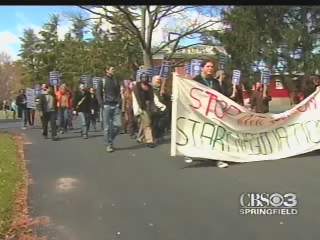
April 22nd, 2007See Springfield CBS 3’s Coverage here
from CBS 3’s newscast:
Members of UMass Amherst’s Graduate Employee Organization, or GEO, are tired of waiting. Made up of more than 2,500 teaching assistants, teaching associates and research assistants the organization has been bargaining with the university for fourteen weeks, without a contract resolution.
For Complete Coverage, Video, and Links to More Video please see:
http://marchonlombardi.blogspot.com
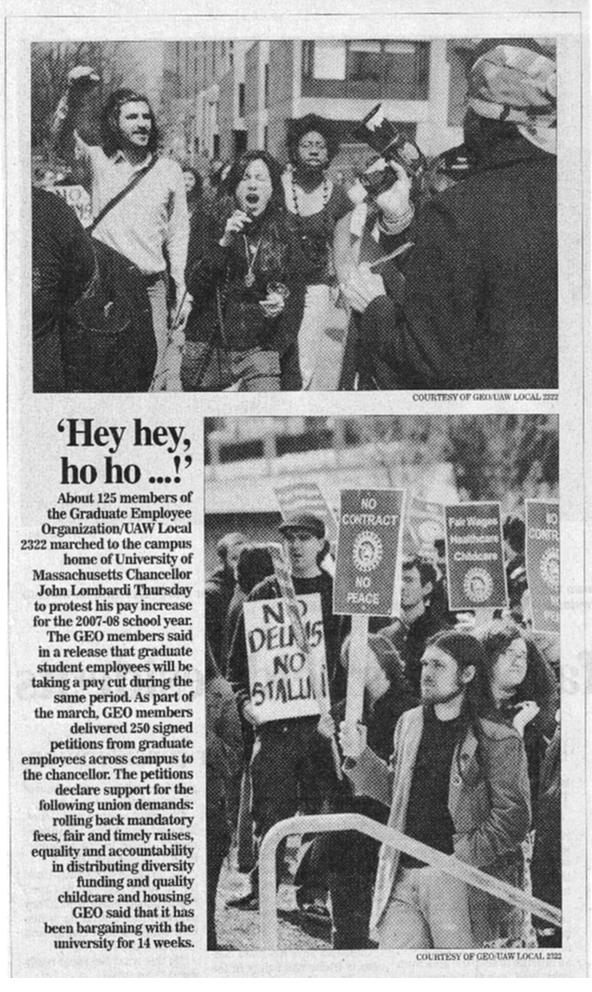
From the Daily Hampshire Gazette:

TODAY 10:45 AM From Student Union to LOMBARDI’S LAWN
April 19th, 2007